Facebook is the latest technology company to offer users a virtual assistant service.
Facebook is testing the artificial intelligence-powered service,
called simply "M," inside its messaging app, Messenger, with some users.
David Marcus, the head of messaging products at the Menlo Park,
California company, says in a Facebook post that M can do things like
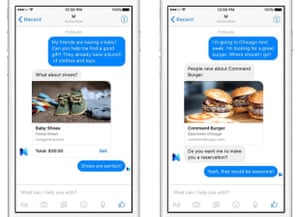
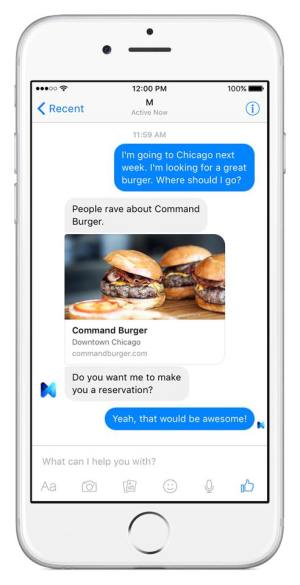
buy items for you, get gifts delivered and book restaurant reservations
or appointments.
Apple's Siri is the most well-known virtual assistant. Microsoft and Amazon also have options.
Marcus says M aims to do more than other digital assistants on the market by completing tasks on the user's behalf.
With more than 700 million users, Messenger is one of the world's most popular messaging apps.
Facebook
is launching a virtual assistant that combines artificial intelligence
(AI) technology with a team of human helpers, to compete with services
such as Apple’s Siri, Google Now and Microsoft’s Cortana.
Facebook M will sit within the social network’s Facebook Messenger
app, with people interacting with it using messages as if it were one of
their friends.
“M is a personal digital assistant inside of Messenger that completes
tasks and finds information on your behalf. It’s powered by artificial
intelligence that’s trained and supervised by people,” explained
Facebook’s messaging boss David Marcus, in a post on the social network.
“Unlike other AI-based services in the market, M can actually
complete tasks on your behalf. It can purchase items, get gifts
delivered to your loved ones, book restaurants, travel arrangements,
appointments and way more.”
Facebook M is currently in tests internally and with a few Facebook
users, with no confirmed launch date to roll it out to the 700 million
users of Messenger.
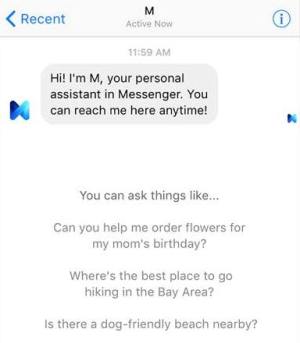
Screenshots published by Marcus show sample queries including “Can
you help me order flowers for my mom’s birthday?”; “Where’s the best
place to go hiking in the Bay Area?”; and “Is there a dog-friendly beach
nearby?”
Facebook M is part of a bigger, ambitious strategy for Messenger to become more than just an app for chatting to friends.
It won’t take long for Messenger’s users to realize M can accomplish
much more than your standard digital helper, suspects David Marcus, vice
president of messaging products at Facebook. “It can perform tasks that
none of the others can,” Marcus says. That’s because, in addition to
using artificial intelligence to complete its tasks, M is powered by
actual people.
Companies from Google to Taskrabbit are engineering products to act
as superpowered personal assistants. Some, like Apple’s Siri, Google
Now, or Microsoft’s Cortana, rely entirely on technology, and though
they can be used by a lot of people, their range of tasks remains
limited. Others, like startups Magic and Operator or gig-economy
companies like TaskRabbit, employ people to respond to text-based
requests. These services can get nearly anything done—for a much smaller
number of folks. M is a hybrid. It’s a virtual assistant powered by
artificial intelligence as well as a band of Facebook employees, dubbed M
trainers, who will make sure that every request is answered.
Facebook’s goal is to make Messenger the first stop for mobile
discovery. Google has long had search locked up on the desktop: Right
now, if I’m looking to treat my summer cold, and I’m in front of my
laptop, I begin by googling “cold meds Upper West Side.” On mobile,
however, I may pull up any number of apps–Google, Google Maps,
Twitter–to find that out, or I may just ask Siri. Facebook starts at a
disadvantage on mobile because it doesn’t have its own operating system,
and therefore users must download an app, and then open it. Marcus
hopes to make up for that by creating a virtual assistant so powerful,
it’s the first stop for anyone looking to do or buy anything.
“We start capturing all of your intent for the things you want to
do,” says Marcus. “Intent often leads to buying something, or to a
transaction, and that’s an opportunity for us to [make money] over
time.”
If M can provide a more efficient service than its competitors,
Facebook can boost the number of people using it on mobile, and
eventually spur revenue from their transactions. That’s the kind of
win-win Marcus was brought in to accomplish at Facebook, which in June
2014 hired him away from PayPal, where he had been CEO. In less than two
years, Facebook has more than tripled Messenger’s users to 700 million.
How It Works
To try the new service, users will tap a small button at the bottom
of the Messenger app to send a note to M, the same way they might
message anyone on Facebook. M’s software will decode the natural
language, ask followup questions in the message thread, and send updates
as the task is completed. Users won’t necessarily know whether a
computer or a person has helped them; unlike Siri and Cortana, M has no
gender. Click to Open Overlay Gallery Facebook
For now, M doesn’t pull from the social data Facebook collects to
complete tasks. So, if you request a gift for your spouse, the service
will make suggestions based only on your answers to questions it asks
you and previous conversations you and M have had. Marcus says that may
change “at some point, with proper user consent.” The service is free,
and will be available to all Facebook Messenger users eventually.
In internal tests, Facebook employees have been using M for several
weeks to do everything from organizing dinner parties to tracking down
an unusual beverage in New Orleans. “An engineer went to Paris for a
couple days, and his friend asked M to redecorate his desk in a French
style,” Marcus says. “Twenty-four hours later, the desk was decorated
with a proper napkin, baguette bread, and a beret.” One of M’s most
popular requests from its Facebook employee testers: the service can
call your cable company and endure the endless hold times and automated
messages to help you set up home wifi or cancel your HBO.
The Human Element
The thing is: that’s a person on hold on your behalf. Facebook’s M
trainers have customer service backgrounds. They make the trickier
judgment calls, and perform other tasks that software can’t. If you ask M
to plan a birthday dinner for your friend, the software might book the
Uber and the restaurant, but a person might surprise your friend at the
end of the night by sending over birthday cupcakes from her favorite
bakery. “M learns from human behaviors,” says Marcus. Click to Open Overlay Gallery Facebook
Eventually, the service might be sophisticated enough to figure this
out on its own, but not soon. Right now, M trainers sit close to the
engineering team inside Facebook offices. The company confirms the
trainers are contractors but won’t say how many there are. Marcus
anticipates that over time, Facebook will employ thousands of them,
which will represent a substantial economic investment.
The company anticipates the cost will be offset by the revenue growth
it is able to realize by capitalizing on M’s interactions. As WIRED’s Cade Metz explains,
Facebook plans to use data generated by the service to feed much more
complex AI systems that can reduce the burden on the trainers.
Open for Business
It’s not hard to imagine the business opportunities that M could
spawn. For one, should Facebook discover a business is getting lots of
inbound requests, it could partner with that company to offer a more
direct, efficient service over Messenger.
“If, for instance, you have a lot of calls that have to be placed by people to cable companies,” says Marcus, “That’s a p retty
good signal that their customers would actually like a better way to
interact with the company and maybe they should have a presence inside
of Messenger directly.”
Facebook is already helping firms offer customer service through
Messenger. At the company’s March developer conference, Marcus announced
Businesses on Messenger, a feature that allows businesses to send
receipts, notify customers their packages have shipped, and provide
basic customer service.
Marcus won’t offer metrics to suggest whether the feature has caught
on among companies, but he says they have shown a lot of interest, and
his team is beginning to work out some of the kinks. “We have a lot of
threads open between businesses and people, and the engagement is very
good,” says Marcus. “Now we want to open it to more businesses.”
Beyond the Valley
Marcus anticipates that M will expand slowly over time, but that it
will eventually reach everyone. As this happens, the array of tasks it
performs will certainly grow. Facebook is, by design, rolling out its
new assistant in a community in which the users are demographically
similar to the M trainers who will be thinking up gifts for their
spouses and fun vacation destinations for them.
It’s safe to say that most of Messenger’s 700 million users around
the world aren’t looking to book an Uber for a friend’s birthday party
or choose between Cancun and Maui for February break. Will M be as good
at helping users in the Bronx access food stamps? How about coming to
the aid of the single mother in Oklahoma who has a last-minute childcare
issue? Marcus is up for the challenge, and so, he says, is M.
M combines the power of a world-leading artificial
intelligence lab with the dexterity of humans Facebook can afford to
hire and the scale of its 700 million user Messenger app.
As I noted earlier,
while Google and Apple were dicking around with the pure science of
artificial intelligence, Facebook used human helpers to brute force a
full-featured assistant. The closest thing to M might be the third-party
app WeSecretary built atop WeChat.
Making M work for all of Messenger’s users might be slow or expensive, but it’ll probably be both.
Eventually, M would ideally work with minimal human
assistance. To get there, Facebook needs time for its M contractors to
teach it the best way to solve problems. With a small workforce and
small beta, that could take a while. Growing M’s test base and the
legions of helpers behind it will cost a ton.
But that’s why Facebook is so distinctly well-equipped. It
has money. Not quite Google or Apple money, but with $4 billion in
revenue and around $700 million in profit last quarter, Facebook has resources to throw at M.
It also has time. Facebook’s ownership of both Messenger
and the 800 million-user WhatsApp gives it a decisive lead in messaging.
It doesn’t have to worry about falling further behind while it
concentrates on R&D. I’m looking at you, Google Hangouts/Messenger.
And finally, with both Messenger and WhatsApp in its
possession, Facebook has arguably the best ways to leverage a chat-based
personal assistant.
How will Facebook recoup this massive investment? There are plenty of ways M could make money.
For example, Facebook could establish relationships with
certain product or service vendors, earning a cut for making them M’s
go-to provider for certain requests. Similar to how Shyp earns money on
the difference between the bulk shipping discounts it gets and what it
charges users, Facebook could surely find some margin to absorb it if it
can power frictionless personal assistant shopping and travel booking.
Then there’s the massive opportunity to run M-triggering
ads. Imagine a Facebook ad that prompts you to message M and set up an
appointment at a local barber or restaurant. Facebook already has “Missed Call” ads
in India that get you to call a business and immediately hang up so you
aren’t charged, then get called back by the business with more info.
And there’s always the potential it could just charge users directly for the service, though that’s really not Facebook’s style.
But the beauty of Facebook’s strategy is that it doesn’t
have to monetize M, or Messenger, directly. While competitors scramble
for ways to earn cash, Messenger lets its parent app handle the
finances.
All Facebook has to do with M is make Messenger more
useful, and thereby used more. The chat app locks people into Facebook’s
social network, and that’s where it keeps the real money-maker: the
ad-filled News Feed.
 Click to Open Overlay Gallery
 Click to Open Overlay Gallery
 Making M work for all of Messenger’s users might be slow or expensive, but it’ll probably be both.
 How will Facebook recoup this massive investment? There are plenty of ways M could make money.